Why Life Feels Strange After a Major Season Ends
What no one tells you about the space that comes after
There is a particular kind of disorientation that does not have a clean name.
The season ended. You were ready, maybe more than ready. The caregiving role, the career, the chapter of life organized around someone else's needs. It is over now. Officially.
And yet something still feels unresolved. The routines have not caught up. The space has not been figured out. You reach, sometimes, for things that are no longer there.
If that sounds familiar, the first thing worth knowing is this: it is not a sign that something went wrong. It is a sign that endings work differently than we have been led to believe.
Here is what is actually happening, and why it takes longer than anyone tells you it will.
The calendar changes faster than we do
A role, a responsibility, a season of life — these can end on a specific date. The routines built around them do not end on schedule. The relationships organized by them, the habits formed within them, the sense of knowing exactly what a Wednesday is for — these linger. They take time to catch up, and that lag is completely normal. It is not a sign that you are stuck. It is a sign that you were genuinely invested in what just ended.
Relief and grief are not opposites
One of the most disorienting things about the end of a demanding season is when the feelings do not arrive in the order you expected. You were ready for it to be over. You know that. And still there is a sense of vacancy that feels harder to move through than you anticipated. That is not contradiction. Wanting something to end and feeling the loss of its structure are two different things. You can hold both without either one canceling the other out.
The endings we do not choose carry an extra layer
There is a meaningful difference between walking toward a door and having it close before you reach it. When a season ends on someone else's timeline — a parent's passing, a restructuring, a circumstance that did not ask for your input — the disorientation can carry additional weight. Not just the loss of the structure, but the loss of agency around when it ended. Both kinds of endings can leave you standing in the same open space. The second one just arrived differently.
Your home often shows the transition before you can name it
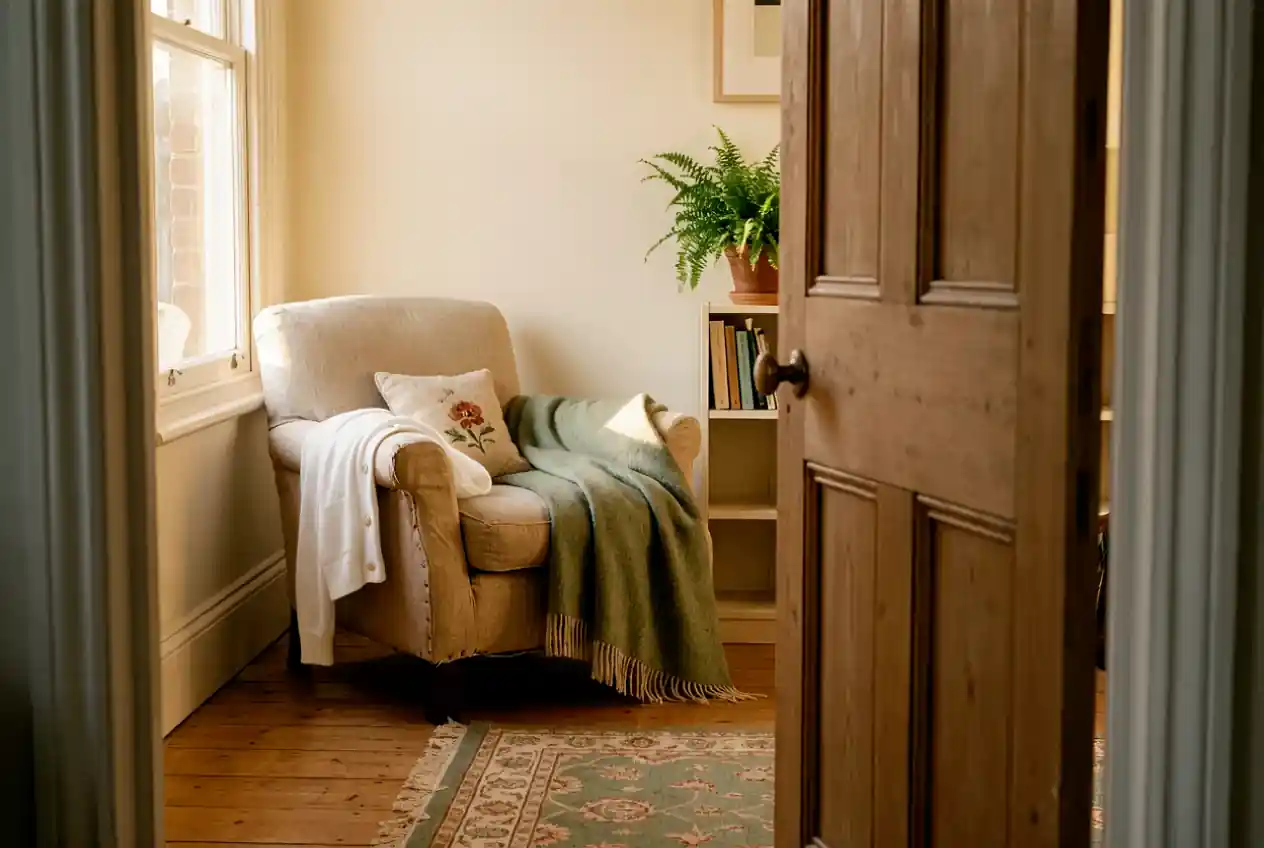
Spaces hold the record of seasons more literally than we realize. The room whose purpose shifted but whose arrangement has not. The corner of the kitchen still organized around a morning routine that no longer applies. The chair where all those calls were taken. None of this is accusatory. It is just honest. Your environment reflects what was there before you have had time to decide what belongs there now. Noticing that is actually the right place to start.
The urge to fill the space quickly is worth slowing down
For capable, high-functioning women, the instinct when a vacancy opens is to fill it. Find the next purpose. Sign up for something. Locate the next thing to organize a day around. Some of that will be exactly right, eventually. But a vacancy is not automatically a problem to be solved on a timeline. Sometimes it is the first honest look at what your days hold when no one else is structuring them. And the question that surfaces in that space — what do I actually want? — is harder to hear when you rush past it.
A reflection to sit with
Is there a space in your home, a room, a corner, an arrangement, that still reflects a season that has already ended? Not as a project to fix immediately. Just as something to notice.
What was that space for? What is it holding now? And what, if anything, does it feel like it is waiting for?
You do not have to have the answers yet. The noticing itself is often the most important first step.
Because you are allowed to let a season be complete before you have finished understanding everything it left behind. That is not being lost.
That is being honest about where you actually are.